Showing posts with label Digital photomontages. Show all posts

Monday, 19 January 2015

Collage Series / Women of Newfoundland and Labrador during the first and second World Wars


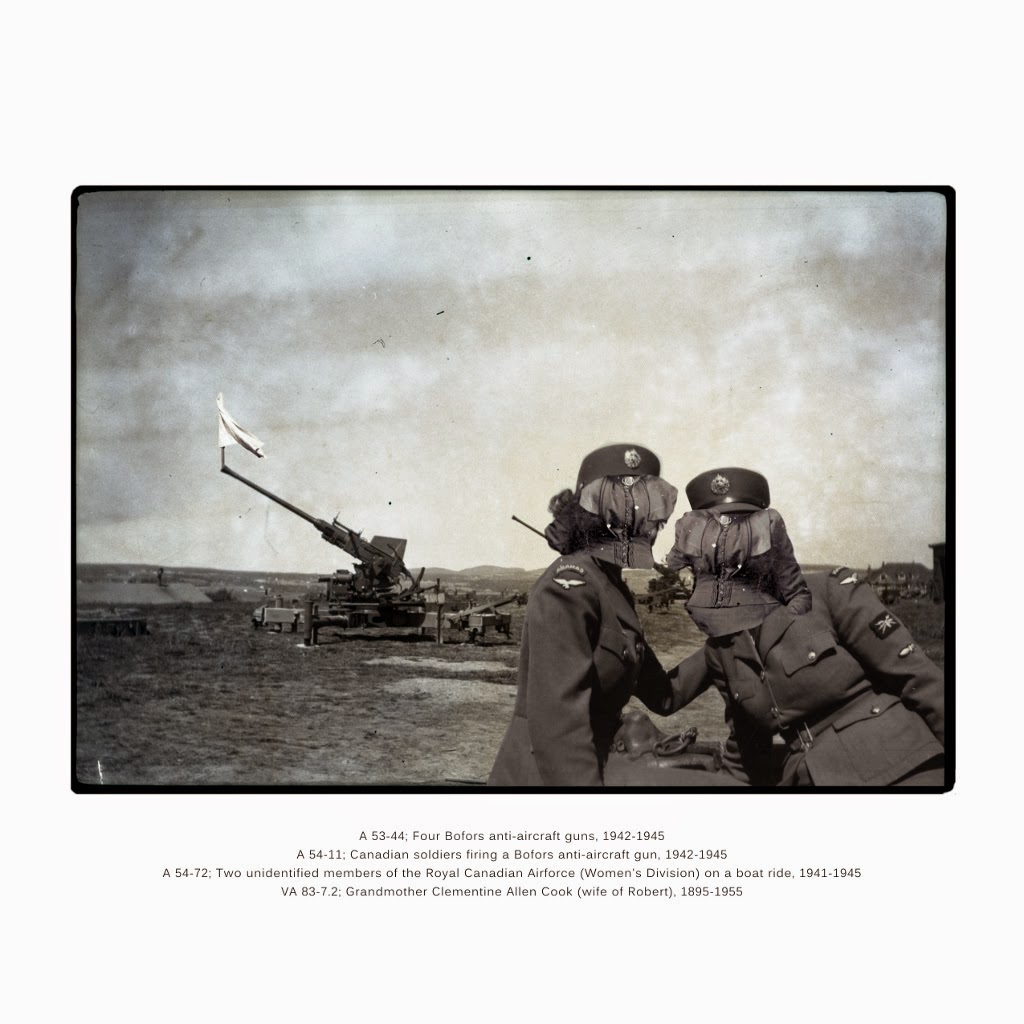
The project Collage Series / Women of Newfoundland & Labrador during the First and Second World Wars, started with an invitation from Mme Vicky Chainey Gagnon, Director Chief Curator of The Rooms Provincial Art Gallery Division, to travel to St-John's, NL, to make a research residency - on Newfoundland & Labrador Women at work during the First and Second World Wars - at The Rooms in the Archives Division. During the two weeks residency in august 2014, I carefully selected archived images to realize a series of 40 collages – from which 32 are presented at The Rooms in the Vitrines on Level 2, from January 15th until September 13th 2015.
Within the framework of this project I investigated the concept of collage along two principal axis in order to precise an aesthetic and procedural approach.
The first axis is related to the mechanical act of tearing asunder – i.e. the act of sampling – that is used in the collage process, no matter the medium, or even art discipline1. Then comes the act of rethinking and recomposing the images to generate a new narrative (a new whole).
Since I was working with archived documents - already scanned by the Archives Division staff - the second axis is more related to notions of realism and supposedly objective visual culture, to question the notion of authenticity of historical archives in this Ubiquitous Computing/Media world we now live in. This brought me to work with digital format, using software tools to reach the blending quality that I was looking for. Since the archived photographs all come from different types of equipments, dates, and stills, a great deal of effort is invested into creating an aesthetically coherent combination of images of different sources. First, for each collage, I selected a background - or environment-like images - in most cases they were pictures of landscape - taken during either between 1914 and 1918 or between 1939 and 1945. The selected background became the starting point of the collage's construction and composition. The other elements that I selected, extracted and recontextualized had to be modified to match the color spectrum and the grain of the background picture, so that the quality of the foreground image was not alien to the background, for the act of collage and combination can be more subtle. This blending approach comes from the intention to make a new image (which is a false reality) that seems as real, or as credible, as the original, in order to question notions of authenticity and evoke the role of remembering through storytelling.
Although the material used for the collages are of a documentary nature, the treatment of the photographic document is not. It can sometimes have the look of a documentary photography, but it is totally constructed. Since most of the reconstructed document respects notions and markers of realism, it may induce ethical problems. That is to say the problem of falsifying reality.
Indeed, most of my collages give a result that is not necessarily looking as a collage at the first glimpse. This is one precise aesthetic moment that I was looking for in this project. Indeed, at this specific short time, there is a collapse between the fake and the apparently real, where our brains and minds have to spend some time to figure out the limits of the collage, its veracity, its ability to cheat reality. This opens many poetical and aesthetic potentials.
This also reminds some parts of my former interest in narration. But this time, the narration is actualized in a real historical framework instead of being inscribed in a purely fictitious and poetic lineage. Here, the narration is more similar to notions of transmission and interpretation of history, maybe as in the case of storytelling. Of course, the actual story is somehow visually told, but also bent and transformed by its complex mythological charge – such as in primitive civilizations where knowledge was orally transmitted but also charged with metaphorical content. Such as eschatology and cosmogony myths marking a transition of an age to another – i.e. the end of life as we know it and the beginning of a new age.
However, here, this is done with great care: I mean without the intention to tend toward a literal and factual history, or even to fall in the trap of the “grand narrative” discourses. This new research and creation project proposes a mythical and narrative constellation anchored in the visual and photographic iconography of that time but without grand narrative or teleological interpretation.
The acts of digital collage and cut-out operate, in themselves, like metaphorical and procedural representations of the despoliation that occurs during war times, and the lives torn in the context of these strong cultural tensions and social transitions. Transitions that were also aligned with a new phase of industrial modernity. Transitions accelerated by technological advances, both industrial and logistical, perfectly representative of the economical and political contexts created by these wars, that literally remodeled the workers' – both men and women - work culture.
Also informed of the most recent writings on cultural heritage in the digital revolution, this new project also plays with, and questions, the place and the culture of museums and archival institutions. Two institutional models that have to redefine and reposition themselves in this digitally-altered historical information-base in relation with the new generation (Cameron et Kenderdine, 2010)2.
1- For example, the well known cut-up technique that William S. Burroughs translated from literature to sound (taped cut-ups), film and mixed media experiments.
2- Cameron F., Kenderdine, S. (Éd.) (2010), Theorizing Digital Cultural Heritage, Cambridge, MIT Press.


Wednesday, 10 April 2013

Drapés

Drapés is a recent visual and sound installation. This project was supported by the Conseil des Arts et Lettres du Québec within the framework of a grant for research and creation. A part of the project was realized during a research and creation residency at Daïmon media art centre in Gatineau, Québec and presented at Centre d'exposition L'Imagier (also in Gatineau).
The starting point of the project was my recent work in digital prints, in painting, in performance and in sculpture, which are all inhabited by a specific element: the drape (le drapé).
The research and creation of images started in November 2010 during an artist residency at Centre Sagamie in Alma, Qc, specialized in large scale prints, with the financial support of Sherbrooke City.

Concept and ideas at the origin of the project
The drape is charged with historic, mythological references, or religious likened as symbols, more or less consciously, by the popular culture. I wish to open reflections on the appearance, the distribution and the transformation of stereotypes through popular imaginary. From the Greek statue, which engraved in the stone the artillery of beauty standards at that time, passing by the uncountable representations of the Saint-Marie, to the popular representations of Death (the Grim Reaper or a corpse lying under a sheet), the drape - predecessor of the sewn and assembled garment - takes place and hides bodies to protect them, to dress them, to mask them, but always by creating a certain mystery, what maintains also, paradoxically, a fascination for the destitution of the hidden body.
For Drapés, the intention is to evoke and to question the solidity and the origin of the current Occidental stereotypes where the drape, alone or near bodies, is the central visual element. How are the current stereotypes still bearers of original symbols? How does information propagation mediatized in masses influence these same simplified symbols? What are the parallels? How, and in which manner, can we reference cohabitation in the context of installation and remind the viewer of the generic variety of senses of an object and so by-pass the fields of influence and the syncretism of the large-scale medias?
With this project I look at fragments of the Occidental history of the drape and its representation. 
 
Physical description
The guiding axis of this project was the creation of a new series of digital images printed on fabrics, and it, to transform these images into long curtains, into flags, into banners, into shrouds (linceuls), etc. The large-scale soft images are blown by the wind produced by industrial ventilators (fans). To revitalize the temporality of interactions between the movements of the air and the drapes, ventilators are connected to a system of control in real time which allows to engage or to interrupt some of the ventilators. Through this windy landscape one finds some emergency vehicle revolving lights. The later being, with the video, the only light source in the installation.
Sound was approached as follows: composition is one of silences, acoustic sounds and light sonifications of the electric devices present in the installation. We wished to leave a place with the acoustic sounds: beating and banging of fabric, curtains and flags. Then, we used electromagnetic sensors to make slightly audible the humming from the sources of movement of the soft images, added to an irregular electroacoustic crackling of the revolving lights.
Finally, a digital stop motion video was created during an artist residency at Daïmon media art centre to be projected inside the installation.
Drapés relies on finding a balance between the coexistence of different types of representation within a global perspective. The project wants, above all, to be considered as a new research in installation in which the main objective is to create a whole ensemble which appears as a rich and opened evocation of symbols, references and positioning.


Tuesday, 11 October 2011

Télétoxie Remix

Télétoxie Remix is a second version of the project Télétoxie. We redesigned the installation, and explored new ideas, so it could be adapted to the gallery space of L'Écart, lieu d'art actuel, Rouyn-Noranda, Qc, 2011.


Wednesday, 3 August 2011

TÉLÉTOXIE

Visual and sound installation in collaboration with Philippe-Aubert Gauthier 

The project started thanks to a grant for research and creation in media art from the Conseil des Arts et Lettres du Québec (CALQ) in 2009. First artist residency, for the sound aspect of the project at Diapason sound art gallery, Brooklyn, New York, USA, 2009. Later the sound composition and spatialization was done at Oboro (an artists-run center in Montréal, Canada). Second artist residency at the Studio d'Essai of Les Productions Recto-Verso in Québec City supported by a grant from Sherbrooke's City.

Concept and ideas at the origin of the project
If, during the last century, the development of transport largely participated to the city's space composition and function as we know it, the telecommunication techniques pursues the urban and social tissue transformation by accelerating the displacement process: by abolishing the idea of distance with the instant telecommunication. And so, by creating a new urbanity notion: one which is no more attached to the physical zone created by the city, but one which more associated to telecommunication tools and virtualization of exchanges.

Amid the virtualization techniques, new representation modes, we find the video games. Sometimes played alone, sometimes played in network, it becomes in the second case, a reduced form of communication between anonymous beings in visual and sound « mises en scènes »/staging evoking a second city's representation. More often, because of military games popularity, this fictitious representation imply a militarization of the urban space and of the gamers relations.

This project position is at the crossroad of history and thematic of these considerations which gathers military virtual game, the reality and the urban space representation and also the birth of stereotyped representation.
« Télétoxie » is an immersive installation that gathers: photomontages, generative video, dynamic light composition and spatialized sound. This installation is inspired by military video games soundscapes and which directly address the banalized “omnipresence” of death representation in these kinds of games.
Philippe-Aubert Gauthier : sound components
For the creation of the soundscape, sound effect synthesis techniques and algorithms used for Foley sound of video and interactive games were solicited and altered. The aim was to transform and combine these techniques to create a generative and spatialized sound composition. A composition that combined stereotyped sounds (fire, riffles, machines, robots, etc.) in an artificial sound constellation: loud and critic soundtrack of a popular mythology of video game and of the associated virtual representation.
The sound piece is generated in real time and was created such as a new sound symbolic or iconography, and as much in the choice of the primary sound materials, as in the generative composition method which reminds a progressive temporal construction of a sign system with hieratics evocations. The sound work oscillates between this symbolic dimension and a soundscape.
The soundscape is also spatialized in real time. P.-A. Gauthier worked on the sound spatialization with the intention of bringing the Foley sound of video games to a human scale, literally creating a complete militarized sound environment, as mysterious and poetic as disturbing, to accentuate the scale and the aberrations and inherent excess, such as a schizophrenic temple of video game.
Tanya St-Pierre : visual aspect
The anonymous notion present in some forms of virtual worlds, as in FPS (First Person Shooter) video games, implicates the disappearance of the first real person, ironically, to the profit of a first unique person: the principal character, unique, but shared by isolated players.
Right from the first proto-FPS, the camera becomes the players (character) eyes. Character often represented by a simple armed hand, bizarrely anonymous and simplified. An armed hand alone in a space and context which is constantly renewed from game to game but which, nonetheless, uniformize itself through apparition and proliferation of a mythological constellation of stereotypes.
This anonymous notion inspired the anonymous figure repeated and multiplied within the images of the installation, in the same way that the players of some video games share a unique avatar. The black drape which essentially constitutes the anonymous figure, is a direct reference to the grim reaper, occidental popular representation of death. Death evocation as for interest to open a reflection around extreme violence stereotyped representation banalized within the video game universe.
The anonymous figure also comes from the popular image of the corpse lying underneath a white drape at the morgue. That corpse usually lying in a horizontal position is placed vertically in the photomontages suggesting that the characters in the video games axed on massacre are essentially potential corpse, they are only there to be killed.
Physical description
In the exhibition space one can find a mock-up (replica of the installation). The photomontages used in the video are also presented as publicity panels mounted on wood structures. But here there is nothing to sell, except critical thinking.
The wood pieces displaced on the gallery floor along the walls and the sporadic smoke projected within the installation refers to the « faux-terrains » earlier created to augment panoramic fresco realistic effect, at an era where painting was the hi-tech media of the time to represent military and epic scenes. The later being also representations of combat, victory and death.

Wednesday, 16 September 2009

TÉLÉTOXIE

"Télétoxie" is such an aggravated concretion of subtle cultural changes which live in the explosion of military video game. As a poison, a sneaky weapon, which operates at distance, as a télétoxie.

Media Art Installation at the Studio d'essai in Quebec City with the support of Les Productions Recto-Verso, 2009.
This project was supported by the Conseil des Arts et Lettres du Québec (new media).